Tamil Nadu EB tariff guide
TNEB Tariff Slabs 2026: Understand EB Unit Rates
Use this guide to read Tamil Nadu domestic EB units through TNEB tariff slabs, see why 100 and 500 units matter, and understand why the official bill may differ from a simple rate table.
- Clear domestic slab explanation
- Separates tariff rate from payable bill
- Includes 100-unit and 500-unit notes
- Links to calculator and official verification
Quick answer
What are the TNEB tariff slabs for domestic users?
TNEB tariff slabs 2026 are usage bands for understanding a domestic Tamil Nadu electricity bill. Units are considered across bands rather than multiplied by one rate, while subsidy, fixed charges and the consumer category can change the payable amount. Use the guide for planning, then verify the current official tariff and bill.
This page is an educational guide for domestic users. It is not an official TNERC, TANGEDCO, or TNPDCL tariff order. Always verify final payable amounts on official sources.
How to read the tariff
- Calculate consumed units from your current and previous meter readings.
- Find which slab bands your units pass through.
- Remember that subsidy, fixed charge, taxes, arrears, and bill status can change the payable amount.
- Use the domestic calculator for a quick estimate, then check the official bill before payment.
Domestic EB slab guide
Tamil Nadu EB Bill Slab Rates by Usage Band
The exact official rate can change by tariff order and consumer category, so this table focuses on how users should interpret the domestic slab structure, unit-rate searches, and calculator results without claiming a permanent official rate.
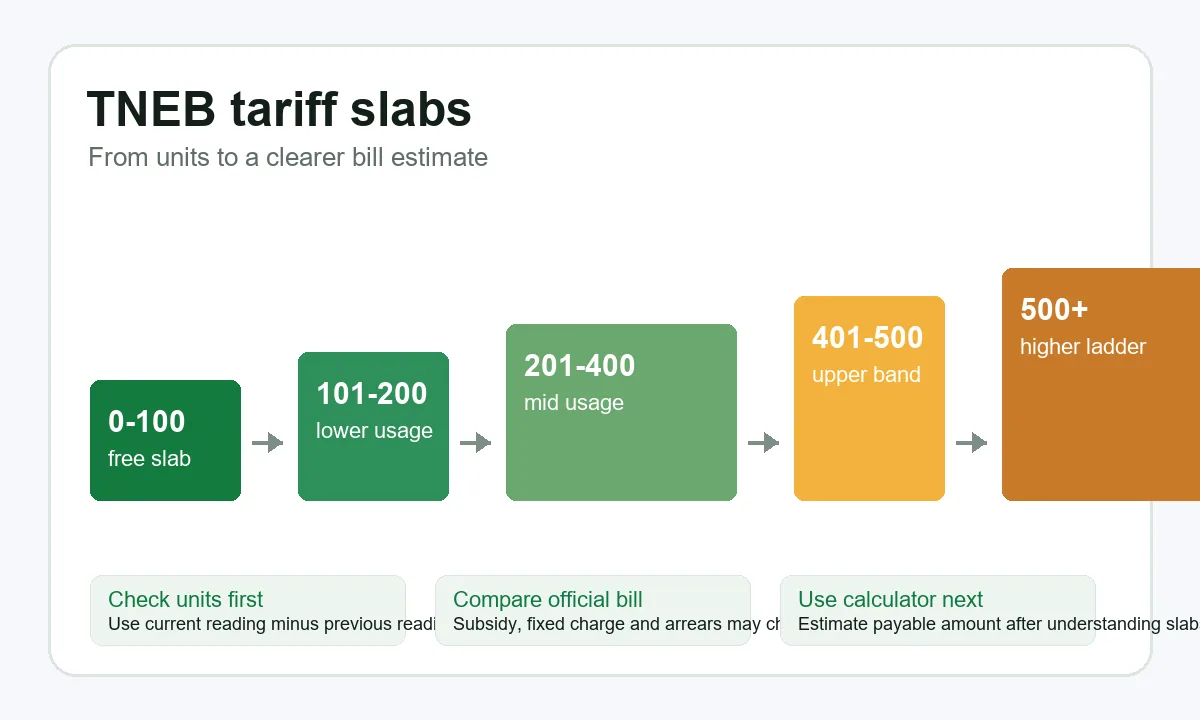
| Usage band | What it means for users | Bill note |
|---|---|---|
| 0-100 units | The first domestic usage band that many household users search as the free 100 units. | Check whether the current bill cycle and service category qualify for the subsidy treatment. |
| 101-200 units | Low household consumption after the first 100 units. | The payable amount may still be small, but official fixed charges and adjustments can matter. |
| 201-400 units | Common mid-range household usage for lights, fans, fridge, and limited AC use. | Use the calculator to see how units are split instead of multiplying all units by one rate. |
| 401-500 units | Upper domestic band before the important 500-unit break point. | Small usage changes near this point can affect the next bill noticeably. |
| Above 500 units | Higher-consumption ladder used after household usage crosses 500 units. | This is why 500 unit and 600 unit searches often show a sharp jump in estimated bill. |
If you need the exact legal tariff wording, use the latest TNERC tariff order and official TANGEDCO or TNPDCL bill portal.
Approved rate vs payable bill
Why a TNEB Unit Rate Is Not Always the Final Bill
Search results often show a unit-rate table, but a real bill can include more than energy charges. These distinctions help avoid over-trusting a simple chart.
Approved tariff
The official tariff order defines category-wise energy rates, fixed charges, and subsidy treatment. Use it when you need legal or category-specific confirmation.
Calculator estimate
A calculator turns consumed units into a practical estimate. It is useful for planning, but it should not replace the official service record.
Payable bill
The final payable amount may include arrears, taxes, meter status, previous adjustments, rounded amounts, penalties, or subsidy changes.
Unit-rate searches need context
Searches like tneb unit rate, 1 unit electricity cost in Tamil Nadu, and tamil nadu electricity tariff are often answered better by explaining slab bands first. A single per-unit number can mislead users because domestic bills are calculated across bands.
Official tariff order check
Use this page for practical interpretation, then verify category-specific rates, subsidy wording, fixed charges, and effective dates through official TNERC, TANGEDCO, or TNPDCL sources before making payment decisions.
Unit examples
How to Use Slabs Before Calculating a Bill
The safest workflow is to understand the band, then calculate. This prevents the common mistake of applying one per-unit price to every unit.
For exact payment, use the official portal after using the estimate.
Practical workflow
- Use the reading calculator if you only have current and previous meter readings.
- Open the domestic bill calculator when you know consumed units.
- Compare the result with the slab guide to understand why the amount changes.
- If your service is a shop or office, use the commercial calculator instead.
Example: 500 vs 600 units
A 500-unit domestic estimate and a 600-unit estimate can differ more than users expect because usage above 500 enters a different higher-consumption ladder. The calculator helps show the split instead of hiding it behind one total.
Official verification
Verify Tariff and Payment Details Officially
Use this guide for understanding and planning. Use official TNERC tariff orders and the TANGEDCO or TNPDCL portal for legal rate interpretation, bill status, payment, arrears, and receipts.
Tariff FAQ
TNEB Tariff Slabs FAQ
What are the TNEB tariff slabs for domestic users?
Domestic TNEB tariff slabs group usage into bands such as 0-100, 101-200, 201-400, 401-500 and above 500 units. The exact payable amount still depends on the current tariff order, category, subsidy, fixed charges and bill adjustments.
Is 1 unit electricity cost in Tamil Nadu the same for every unit?
No. Domestic bills are slab based, so the effective cost changes as usage crosses bands. A single unit price can be misleading for a full bill estimate.
Why is 500 units important in a TNEB bill?
The 500-unit point matters because higher-consumption calculation rules can apply after that level. Users often notice a sharper bill increase when usage moves from around 500 to 600 units.
Can I use this tariff guide as an official rate order?
No. This guide explains the slab concept for planning. Use official TNERC tariff orders and TANGEDCO or TNPDCL bill pages for official confirmation.
Which calculator should I use after reading this guide?
Use the domestic TNEB bill calculator for household units, the reading calculator if you need to find consumed units first, and the commercial calculator for shop or business connections.
What is the best way to check the current TNEB unit rate?
Use this guide to understand the slab structure, then check the latest official tariff statement or bill portal for category-specific payable rates, fixed charges, subsidies, and effective dates.
Should I multiply all units by one Tamil Nadu EB unit rate?
No. Domestic bills are slab based. Split the consumed units across the relevant bands or use the bill calculator, then verify the official payable amount before payment.
What does TN EB unit price mean?
TN EB unit price is a shorthand search phrase, not one universal household rate. Tamil Nadu billing uses slabs, category rules, subsidies, fixed charges and effective dates, so confirm the current official tariff before treating one per-unit figure as the final rate.