Tamil Nadu domestic EB guide
How TNEB Bill Is Calculated: Units, Slabs and Examples
Understand how a TNEB or TANGEDCO household bill moves from meter readings to consumed units, slab charges and the final amount due. Use the method for checking an estimate, then verify the official bill.
- Start with the current and previous readings
- Split units across the applicable bands
- Keep subsidy and other bill lines separate
- Use the official record for the amount payable
Quick answer
How is a TNEB bill calculated?
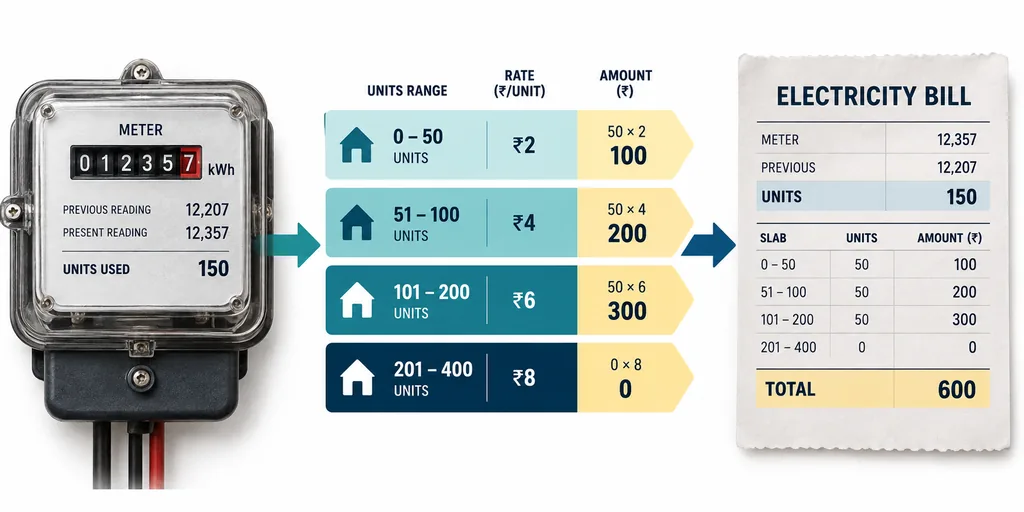
The short answer to how TNEB bill is calculated is a reading difference followed by band allocation. A domestic TNEB bill starts with the units used during the billing period. Subtract the previous meter reading from the present reading, allocate the result across the tariff bands that apply to the service, and total the energy charges. The bill can then show subsidy treatment, fixed or meter-related lines, arrears, adjustments, penalties or other category-specific entries. That is why one unit-rate search is not the same as the final amount on your bill.
Tariff orders, subsidy rules and service categories can change. This page explains the calculation logic; it is not an official tariff order or payment confirmation.
The five checks
- Find the billing period and confirm that the bill is for your service connection.
- Record the present and previous readings exactly as printed.
- Subtract the previous reading from the present reading to get units consumed.
- Apply the current domestic slab structure and any qualifying subsidy treatment.
- Compare the estimate with each bill line before paying through an official route.
The bill formula
The lines that turn units into a payable amount
The formula is easier to audit when each part stays separate. Do not hide every line inside a single guessed per-unit price.
1. Consumed units
Present reading minus previous reading gives the usage for the bill period. Check the dates as well as the digits.
2. Slab energy charge
The units are divided into the bands in the current tariff schedule. Each band can have its own rate, so a higher band does not automatically price every unit at that rate.
3. Subsidy or benefit
A qualifying domestic subsidy can reduce or waive part of the energy charge. The treatment depends on the current order and the service category.
4. Other bill lines
Fixed charges, meter items, arrears, adjustments, taxes, delayed-payment amounts or category-specific charges may appear separately.
5. Net amount
The official bill combines the applicable lines, rounds the result where required and states the amount due and due date.
Use the current TNERC tariff order and the bill issued for your service when a legal rate, subsidy or category question matters.
Read the source numbers first
How to get the correct units from a TNEB bill
The most common mistake is entering the full meter reading into a calculator. The meter reading is a running total. The bill uses the difference between the present reading and the previous reading, adjusted for the dates and any official assessment. For example, a present reading of 18,750 and a previous reading of 18,400 gives 350 units for that period. Keep the original readings in your notes so you can explain a mismatch later.
Check whether the bill shows an actual reading, an assessed reading or a reading carried forward from an earlier period. If a meter could not be accessed, a provisional assessment can make one bill look unusually high or low; the next bill may include an adjustment. Do not silently replace an assessed figure with a guess. Mark the line, photograph the meter when safe, and use the official complaint route if the difference remains unexplained.
Also check the service category before using a domestic example. A shop, office, apartment common area or high-tension service can follow a different schedule from a household connection. The same number of units can therefore produce a different result. This guide focuses on the domestic calculation idea and links to the site's commercial calculator for planning only.
A repeatable workflow
Calculate a TNEB bill without hiding the assumptions
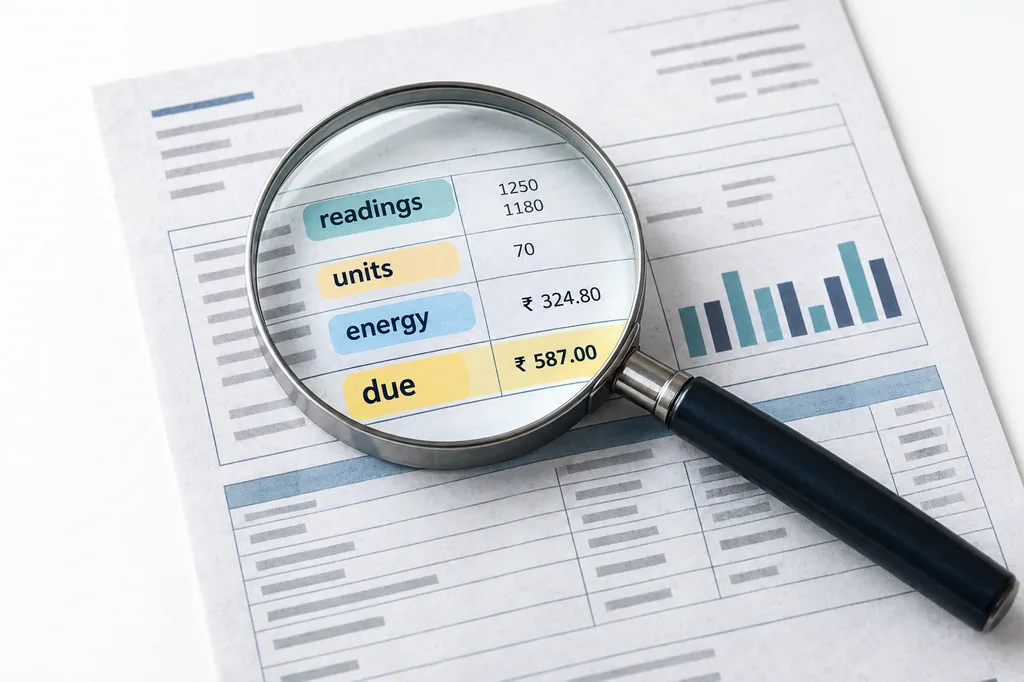
A transparent estimate records the source readings, the billing period, the tariff version, each band allocation and the non-energy lines. This makes it possible to find whether a difference came from units, a threshold, subsidy treatment, an adjustment or a payment record.
Small reading example
Present reading 18,750 minus previous reading 18,400 equals 350 units. The number 350 is the input for a domestic estimate; 18,750 is not. The official bill still controls the final rate, subsidy, adjustments and amount due.
Step-by-step
- Write down the service number, bill month and billing dates without sharing them with an unofficial contact.
- Copy the present and previous readings and calculate the difference in units.
- Select the current domestic tariff schedule that matches the service category and effective date.
- Allocate units from the first band upward; record the units and rate used for every band.
- Apply a subsidy only when the current order and bill show that the service qualifies.
- Add the remaining bill lines and compare the result with the official amount due.
Worked example
How a 350-unit example is split
This table demonstrates the structure without claiming a permanent rate. Replace the band labels and rates with the current schedule shown on your bill or tariff order.
| Band | Units allocated | Rate used | Line calculation |
|---|---|---|---|
| First band | 100 | Current band rate | 100 x rate 1 |
| Second band | 100 | Current band rate | 100 x rate 2 |
| Third band | 150 | Current band rate | 150 x rate 3 |
| Energy subtotal | 350 | Not one flat rate | Line 1 + line 2 + line 3 |
| Subsidy or benefit | As shown on bill | Current rule | Subtract only when eligible |
| Other charges | As shown on bill | Category-specific | Add or adjust by bill line |
| Net amount due | Official total | Final record | Use the issued bill for payment |
The example teaches allocation, not a guaranteed price. A tariff revision or a different service category changes the rates and other lines.
Why bills differ
What can change the result after the unit math
A slab table is only one layer of a TNEB bill. When someone asks how TNEB bill is calculated, the answer must include every applicable band. Search results often show a convenient rate for a single band, but a domestic bill can cross several bands during one billing period. A flat multiplication can therefore overstate the lower units or understate the higher ones. The safest estimate shows the allocation row by row and labels every rate with the tariff date used.
The billing cycle matters when you compare households or months. Tamil Nadu domestic bills are commonly issued on a roughly two-month cycle, but the exact period and meter dates belong to the official bill. Do not divide units by two before applying the tariff unless the schedule explicitly asks for a monthly view. Divide the final amount only when you are presenting a monthly-equivalent comparison, and label it as an average rather than a second bill.
Thresholds deserve a separate check. A change of a few units near an important band can alter the calculation ladder or the subsidy treatment. That is why a 499-unit estimate cannot be assumed to be the same as a 501-unit estimate plus two extra units. Read the current threshold language, record the total period units and compare the official bill when the jump seems larger than your appliance use suggests.
The bill can also contain information that a calculator does not know: an arrear from an earlier period, a credit, a meter replacement adjustment, a provisional assessment, a delayed-payment amount or a category change. These are not errors simply because they are absent from a unit calculator. Match the bill number, dates and service category before opening a complaint, and keep a copy of the page or PDF you are checking.
Common mistakes
Six checks before you call the amount wrong
Most apparent calculation errors come from mixing a running reading, a bill period and a final payable record.
Using the present reading as units
Subtract the previous reading first; a meter is cumulative, not a bill-period counter.
Using one rate for every unit
Split the total through the applicable bands and keep the rates tied to an effective date.
Comparing different categories
Domestic, commercial and other service categories can use different schedules and charges.
Ignoring an assessed reading
Check whether the meter was read, estimated or adjusted before treating a change as a tariff problem.
Forgetting non-energy lines
Arrears, credits, adjustments, penalties and subsidies can change the final amount after unit math.
Paying from an unofficial link
Use the official domain and never share OTP, PIN, password or remote-access details.
Official verification
Use the estimate, then check the issued bill
This guide does not connect to a consumer account or confirm a payment. Use the official portal or the bill issued for your service when you need the current amount, receipt, arrear or due-date record.
FAQ
How TNEB bill calculation works: FAQ
How is a TNEB bill calculated from meter readings?
Subtract the previous reading from the present reading to get consumed units, allocate those units across the current tariff bands, apply eligible subsidy treatment, then reconcile the remaining bill lines and official amount due.
Should I enter the full meter reading in a calculator?
No. A meter reading is a running total. Use present reading minus previous reading, then enter only the consumed units for the billing period.
Is one TNEB unit rate used for the whole bill?
Usually not for a domestic slab calculation. Units can be split across bands, and the final bill can also include subsidy, arrears, adjustments or other lines.
Why can two bills with similar units differ?
Check billing dates, service category, assessed readings, thresholds, tariff effective dates, subsidy treatment, arrears and adjustments before assuming the unit math is wrong.
Does this page show my official amount due?
No. It explains the method and provides planning links. The issued bill and official account portal control the payable amount, due date and receipt status.
Can I use this method for a shop connection?
Use the service category and tariff schedule that apply to the shop. The domestic examples on this page should not be treated as a commercial bill calculation.
What should I keep if the bill looks wrong?
Keep the bill, service details, billing dates, previous and present readings, a dated meter photo and a factual description of the line that does not match.